
Toilet, Faucet and Disposal Repair
Small plumbing jobs have a way of piling up. The hall toilet runs for a few seconds every hour, the kitchen faucet drips unless the handle sits just right, the disposal hums but will not spin, and the valve under the bathroom sink has not turned in years. None of them is an emergency on its own. Together, they are a morning's work for a plumber and a steady drain on the water bill.
Montgomery Plumbing Pros connects homeowners with independent local plumbers. Listing every small problem in one request is often the best way to get a single visit quoted, and the plumber you hire can tell you which items are worth fixing and which parts are better replaced.
Running and rocking toilets
A toilet that runs on its own, or refills with a hiss every so often, is almost always leaking from the tank into the bowl. The usual culprit is a worn flapper that no longer seals, a chain that is too short, or a fill valve set too high so water spills into the overflow tube. Put a few drops of food coloring in the tank; if color shows up in the bowl within about ten minutes without flushing, the flapper is leaking.
A toilet that rocks is a different problem. The wax ring under it seals the toilet to the drain, and once the bowl moves, that seal breaks. Water can seep under the floor every time it flushes, which shows up as a soft floor, a stain on the ceiling below, or a sewer smell. A plumber will pull the toilet, check the flange it bolts to, replace the seal and reset it solid. If water has been getting under the floor for a while, the damage may be worth a closer look, the way you would chase a leak that is not at the fixture.
Dripping faucets and worn cartridges
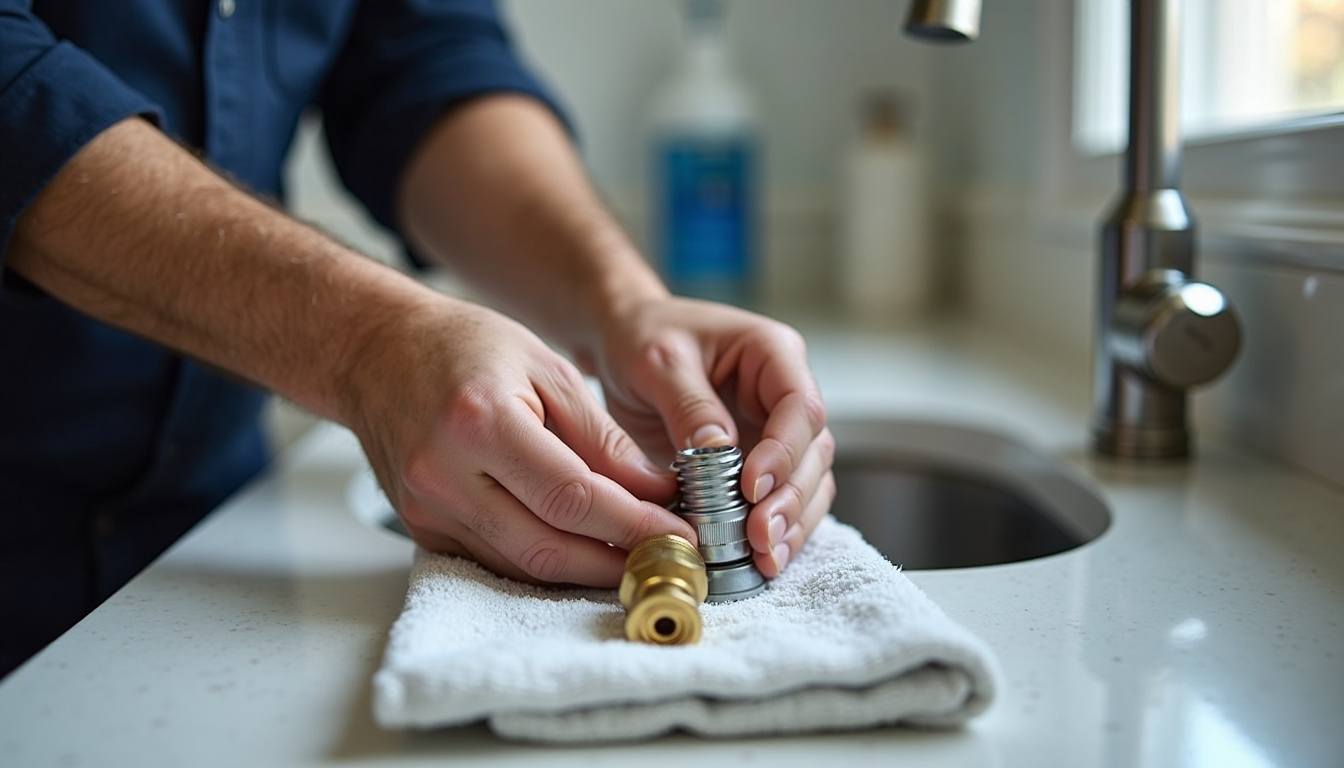
Most modern faucets use a cartridge or a ceramic disc instead of the old rubber washer, and when they start dripping, the fix is usually replacing that part along with its O-rings and seats. Older two-handle faucets may still use washers. The catch is finding the right part. A plumber who knows the common brands can often match it on the spot, and will tell you if a faucet is old or obscure enough that a new one costs less than chasing parts.
Leaks under the sink matter as much as drips at the spout. Check the supply lines from the shutoffs to the faucet. Older braided lines and plastic connectors can crack with age, and a failed supply line under pressure can put a lot of water into a cabinet quickly.
Mineral build-up on fixtures
White crust around an aerator, a showerhead that sprays sideways, or a faucet that has slowly lost pressure is usually mineral build-up. All tap water carries some dissolved minerals, and they collect where water sits and evaporates. Unscrewing the aerator and soaking it in vinegar often fixes weak flow at one faucet. If every faucet in the house has lost pressure, the cause is more likely in the pipes, especially in an older house with galvanized supply lines, and that is a different conversation.
Inside a cartridge or toilet fill valve, the same deposits wear seals and make parts stick, which is one reason these parts wear out on a schedule of years rather than decades.
Garbage disposals
A disposal that hums but does not turn is usually jammed. With the power off at the switch, a hex key in the socket on the bottom of the unit can free the grinding plate, and the red reset button underneath restores power after the motor's overload trips. A disposal that does nothing at all may have tripped that reset or a breaker. One that leaks from the bottom of the housing has usually corroded through and needs replacing, while a leak at the sink flange or the drain connection can often be resealed.
Disposals also connect to the dishwasher drain, so a jammed or clogged unit can leave standing water in the dishwasher. If water backs up in the sink even with the disposal running, the clog may be in the drain line past it, which is a clog that sits deeper in the line rather than a disposal problem.
Old shutoff valves
Every toilet and sink should have its own shutoff valve, so you can stop the water at one fixture without shutting off the house. In older homes, those valves are often multi-turn valves with rubber washers that harden over the years. They may not close all the way, may leak from the stem when turned, or may not turn at all. Swapping them for quarter-turn valves when a plumber is already working on the fixture is a small add-on that makes the next repair easier. The same goes for the main shutoff: if you have never turned it, it is worth knowing whether it works before an emergency. Homeowners from Tallassee down to the capital run into the same tired valves.
How small jobs are priced
Many plumbers charge a minimum for a visit or a trip charge, and then price each repair. That is why bundling makes sense: a running toilet, a dripping faucet and two stuck shutoffs on one visit cost less than four separate visits. Parts are usually extra, and a fixture you buy yourself may or may not be something the plumber is willing to install. Ask before you buy. A written list with each repair priced separately makes it easy to drop one if the total runs high. If the plumber suggests replacing a fixture instead of repairing it, ask for both prices.
Send your list
Write down every small problem, including the ones you have learned to live with, and send the form. Photos of the faucet or disposal model help. If a supply line under a sink has burst, close the small shutoff valve behind it, or the main if that one will not turn. We connect you with an independent local plumber who does this kind of work.